
Worcester Boiler No Hot Water: Pressure, Diverter Valve and Faults Explained
There’s never a good time for your Worcester boiler to stop producing hot water.
One minute you’re expecting a hot shower, and the next you’re standing there wondering why only cold or lukewarm water is coming out of the tap. It sounds obvious, but this is one of the most common reasons homeowners call us at WPJ Heating.
The good news is that a Worcester boiler no-hot-water issue doesn’t always mean you need a new boiler. In many cases, the problem can be traced back to low pressure, a faulty diverter valve, a blocked heat exchanger, thermostat issues, or one of several other common faults that affect Worcester Bosch boilers.
We’ve diagnosed hundreds of hot water issues over the years, and while every situation is different, the same common culprits tend to appear again and again.
In this guide, we’ll explain Worcester boiler no hot water pressure diverter valve and faults explained in plain English. We’ll cover what causes the problem, what DIY checks you can safely carry out, when a professional repair is needed, and when it’s time to call a Gas Safe engineer.
Why Is My Worcester Boiler Not Giving Me Hot Water?
If your Worcester Bosch boiler still works for heating but not hot water, that’s actually a good indicator.
Combi boilers are built to supply both heating and hot water from a single unit. If one of the functions works and the other doesn’t, that’s usually a sign of a specific component issue rather than a total boiler failure.
Some of the most common causes include:
- Low boiler pressure
- A faulty diverter valve
- A blocked heat exchanger
- A faulty thermostat
- Trapped air within the system
- A frozen condensate pipe
- Gas supply issues
- Internal electronic faults
- Worcester boiler error codes causing the boiler shuts down process
Let’s break down each one of these.
Check Your Boiler Pressure First
Check the pressure gauge on your boiler before jumping to conclusions.
Most Worcester Bosch boilers are most efficient at between 1 to 1.5 bar when cold. If the pressure gauge reads below this level, the hot water performance may be impaired.
We’ve attended countless call-outs where customers thought they needed an expensive repair, only to discover the system simply had low pressure.
How Low Pressure Causes Hot Water Issues
Modern Worcester boilers have built-in safety features.
When the pressure falls too low, the boiler may:
- Stop producing hot water
- Displaying error codes
- Fail to ignite properly
- Shut down certain functions
- Cause inconsistent water flow
If your Worcester boiler has low water pressure, there’s a good chance this is contributing to the fault.
How To Repressurise A Worcester Boiler
Most Worcester Bosch boilers can be repressurised using the filling loop.
Although the process varies slightly between models, the general approach is:
- Locate the filling loop.
- Slowly open the valve.
- Watch the boiler’s pressure gauge.
- Stop filling when the pressure reaches around 1.5 bar.
- Close the valve securely.
Always refer to the boiler manual for your specific model.
If the pressure keeps dropping, that’s often a sign of a leaking boiler, faulty components, or other potential issues that require investigation.
Faulty Diverter Valve Problems Explained
If your radiators get hot but your taps don’t, the diverter valve is often the first thing we check.
What Does A Diverter Valve Do?
The diverter valve controls where heated water travels within the system.
When you turn on a hot tap, the valve redirects heated water away from the heating system and towards your water outlets.
Without a working diverter valve, hot water flowing through the boiler may never reach your taps properly.
Symptoms Of A Faulty Diverter Valve
A faulty diverter valve can cause:
- Cold or lukewarm water
- Inconsistent hot water temperature
- Heating coming on when using hot water
- Reduced flow
- Warm water rather than properly hot water
This is one of the most common reasons we see a Worcester boiler producing heating but not producing hot water.
Why Diverter Valves Fail
Like any moving valve, wear and tear eventually takes its toll.
Common reasons include:
- Limescale build-up
- Internal wear
- Debris inside the system
- Faulty actuator mechanisms
- Age-related component failure
Fortunately, a faulty diverter valve can often be repaired or replaced without needing a complete boiler replacement.
Other Common Worcester Boiler Faults
Blocked Heat Exchanger
The heat exchanger is responsible for transferring heat to your hot water supply.
A blocked heat exchanger can restrict flow and reduce temperature.
Symptoms include:
- Poor water flow
- Cold water at taps
- Warm rather than hot water
- Reduced efficiency
Frozen Condensate Pipe
During freezing temperatures, the white plastic pipe running externally from your boiler can freeze.
A frozen condensate pipe or blocked condensate pipe can cause the boiler’s shut-down safety mechanism to activate.
Signs include:
- Gurgling noises
- Fault codes
- Boiler not firing
- Loss of heating and hot water
In some situations, you may be able to carefully pour warm water over the frozen section to thaw it.
However, always follow manufacturer guidance and avoid boiling water.
Faulty Thermostat
A faulty thermostat can cause temperature readings to become inaccurate.
If the thermostat isn’t set correctly or develops a fault, hot water performance may be affected.
Common signs include:
- Incorrect temperature control
- Water turning hot then cold
- Boiler cycling unnecessarily
Trapped Air In The System
Air pockets can occasionally affect circulation.
Trapped air may cause:
- Poor flow
- Noisy pipework
- Intermittent hot water issues
- Reduced system performance
Gas Supply Problems
Without a reliable gas supply, your boiler cannot generate heat.
Gas-related faults may involve:
- Supply interruptions
- Isolation valves being closed
- Internal gas faults
Always contact a Gas Safe registered engineer if you suspect a gas-related issue.
Worcester Boiler Error Codes
For most Worcester Bosch boilers when something goes wrong a fault code will be shown on the control panel.
Common error codes can relate to:
- Pressure issues
- Ignition faults
- Sensor failures
- Condensate problems
- Circulation faults
Error codes are helpful but don’t always tell you where the trouble is.
We’ve all seen boilers throw error messages that seem to point in one direction but the underlying problem turns out to be something quite else.
That’s why proper diagnosis is important.
Safe DIY Checks Before Calling An Engineer
There are a few DIY checks homeowners can safely carry out:
- Check boiler pressure
- Check the pressure gauge
- Confirm thermostat settings
- Check the gas supply
- Look for leaks
- Check the condensate pipe
- Review any fault codes
- Press the reset button if recommended in the boiler manual
If the hot water returns after these checks, fantastic.
If not, avoid repeatedly trying to reset the boiler, as this can sometimes lead to further damage.
When Should You Call A Gas Safe Engineer?
If you’ve carried out the basic checks and the fault remains, it’s time to contact a professional.
You should arrange a professional repair if:
- The boiler repeatedly resets
- The boiler shuts down frequently
- Pressure keeps dropping
- You suspect a leaking boiler
- Fault codes continue appearing
- The fault keeps returning
A Gas Safe engineer has the equipment and expertise needed to diagnose faults safely and accurately.
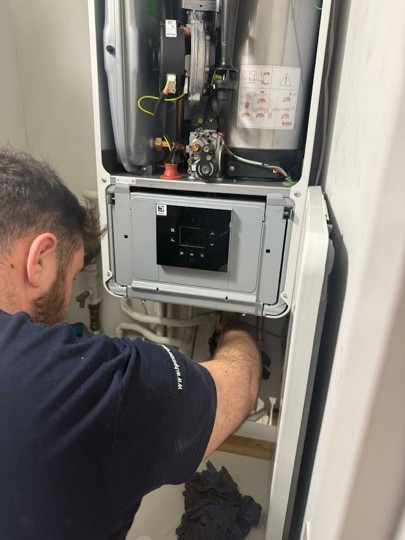
How We Diagnose Worcester Boiler Hot Water Faults
At WPJ Heating, we don’t believe in guessing.
When we attend a Worcester boiler repair, we systematically inspect:
- Boiler pressure
- Water flow
- Heat exchanger performance
- Diverter valve operation
- Thermostat function
- Gas supply readings
- Electronic components
- Error codes stored within the control panel
Over the years, we’ve learned that accurate diagnosis is often the difference between a lasting repair and an expensive guessing game.
Frequently Asked Questions
Q: Why is my Worcester boiler heating the radiators but not producing hot water?
A: It is usually a bad diverter valve, a blocked heat exchanger or a broken sensor. These components affect hot water production alone, but the heating can operate nonetheless.
Q: What pressure should my Worcester boiler be?
A: Most Worcester Bosch boilers should rest at a pressure between 1 and 1.5 bar when cold. Always consult your boiler handbook for advice relevant to your unit.
Q: Can low pressure stop hot water working?
A: Yes. Low pressure is one of the most prevalent reasons for Worcester boiler hot water problems and can stop the boiler working correctly.
Q: Can I reset the boiler myself?
A: Yes, in a lot of circumstances. Normally you can press the reset button following the directions in your boiler manual. But repeatedly resetting the device without fixing the root cause of the error, isn’t encouraged.
Q: When should I call a Gas Safe registered engineer?
A: If the pressure continues to drop, the boiler is showing error codes, there’s a leak, gas issues or no hot water after simple checks, call in the professionals.
Conclusion
A Worcester boiler no hot water malfunction might be frustrating but doesn’t necessarily signal a severe breakdown.
From low pressure and faulty diverter valve issues to frozen condensate pipes, thermostat faults and blocked heat exchangers, there are several common causes that can stop your boiler producing hot water properly.
The trick is to discover the root cause early. Simple inspections such as checking the pressure gauge, checking the filling loop, checking the condensate pipe and checking for fault codes can frequently provide important hints.
If the problem persists, a Gas Safe-registered engineer can safely analyse the problem and offer the most suitable remedy.
At WPJ Heating, we regularly diagnose and repair Worcester Bosch boiler faults. Whether you’re dealing with cold taps, inconsistent temperature, pressure problems or recurring error codes, we’re here to help get your heating system back to full working order.
Disclaimer
This article is intended for general informational purposes only and should not be considered gas safety, engineering or repair advice. Gas appliances should only be inspected, serviced and repaired by a qualified Gas Safe-registered engineer. Always consult the manufacturer’s guidance and seek professional assistance where appropriate.